Ensuite Renovation: Complete Planning Guide
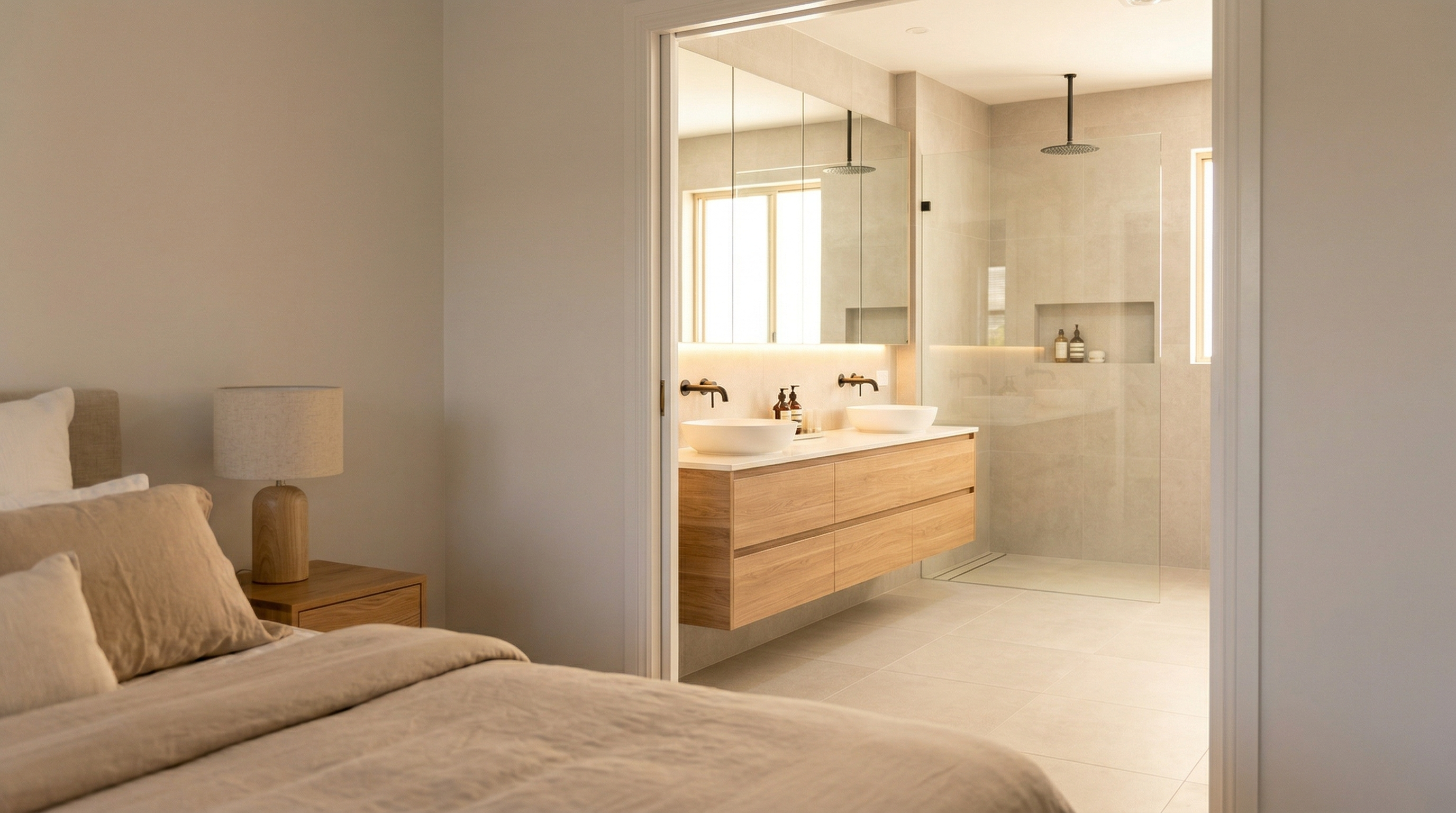
Planning an Ensuite Renovation That Works for Your Home
An ensuite renovation comes with challenges that a main bathroom renovation does not. The ensuite sits directly beside your bedroom, which means noise transfer, dust containment, and access during construction all need careful planning. Layout options are often more constrained because ensuites are typically smaller and share walls with the master bedroom, a hallway, or another wet area. Plumbing access can be limited by the building structure, especially in older Queensland homes where the ensuite was added years after the original build. This guide covers the planning process for an ensuite renovation in Queensland, from initial layout decisions through to completion, so you know what to expect at every stage.
Assess What You Have Before Deciding What You Want
Before browsing tile showrooms or saving inspiration photos, spend time understanding the constraints of your existing ensuite. These physical realities shape what is achievable within your budget:
Measure the space accurately. Record the room dimensions, ceiling height, door swing direction, and the exact positions of existing plumbing (drain points, water supply lines, and the toilet waste pipe). In most Queensland homes, the toilet waste pipe location is the hardest fixture to relocate because it connects to the main drainage stack. Moving it even 500mm can add $2,000 to $5,000 in plumbing costs.
Identify the wall types. Timber-framed walls with plasterboard lining (standard in most Queensland houses) are straightforward to modify. Masonry block walls (common in 1970s-80s brick veneer homes) are more difficult and expensive to cut or move. Load-bearing walls cannot be removed without engineering approval and structural support.
Check ceiling and floor access. In Queenslander homes raised on stumps, plumbers can often access drainage from underneath the house, which simplifies pipe relocations. Slab-on-ground construction (common in newer estates across Brisbane, Gold Coast, and Sunshine Coast) requires cutting into the concrete slab to relocate drains, adding significant cost and time.
Note the window position. If your ensuite has a window, its location affects where you can place the shower (you generally want to avoid a showerhead spraying directly at a window). Windows also provide natural ventilation, which is valuable in Queensland’s humid climate. If the ensuite has no window, mechanical ventilation becomes a critical part of the renovation plan.
Ensuite Layout Options for Queensland Homes
Ensuites in Queensland homes range from generous walk-in designs in newer builds to narrow galley-style spaces carved out of former verandahs in older houses. Here are common layout configurations:
Single-wall layout: All fixtures (shower, toilet, vanity) line up along one wall. This works in narrow ensuites (1,200 to 1,500mm wide) and keeps plumbing consolidated on a single wall, reducing costs. The opposite wall stays clear, making the room feel wider.
L-shape layout: The shower occupies one corner, with the vanity and toilet arranged along the adjacent wall. This uses corner space efficiently and allows a larger shower than a single-wall arrangement would permit.
Double-vanity layout: If the ensuite is wide enough (2,000mm or more), a double vanity provides separate wash spaces. This is popular in new Queensland builds where the ensuite serves as the primary bathroom for a couple. Consider whether both sinks need full plumbing or if a single drain line with a Y-junction will suffice.
Bath-inclusive layout: Fitting a bath into an ensuite requires at least 2,400mm of clear wall length for a standard 1,500mm bath plus access space. Compact 1,200 to 1,400mm baths or Japanese soaking tubs can work in tighter spaces. Discuss options with a bath and shower installation specialist who can assess your specific dimensions.
For any layout change that moves plumbing positions, factor in the cost and timeline impact early. Your renovator should provide a separate line item for plumbing relocations so you can decide whether the improved layout justifies the additional expense.
Noise and Privacy: The Ensuite-Specific Challenge
Because the ensuite shares a wall (or sometimes a door) with the bedroom, noise transfer is a genuine concern that main bathroom renovations rarely face. Flushing toilets, running showers, and exhaust fans at 5am are disruptive to a sleeping partner.
Noise reduction strategies to discuss with your renovator:
- Insulated cavity walls: Adding acoustic insulation batts (minimum R2.0) to the shared wall between the ensuite and bedroom significantly reduces sound transmission. This is easiest to do during a renovation when the wall is already opened up for waterproofing or plumbing work.
- Quiet-flush toilet: Modern cisterns with dual-flush mechanisms are considerably quieter than older models. Some brands offer specific “quiet flush” technology that reduces water noise during filling and release.
- Silent exhaust fan: Standard exhaust fans produce 35 to 45 decibels. Quiet models rated at 25 decibels or below are available and worth the modest price premium for an ensuite. Look for fans with DC motors, which run quieter than AC equivalents.
- Solid-core door: If the ensuite has a standard hollow-core door, replacing it with a solid-core door improves sound isolation noticeably. A door sweep or drop seal at the bottom edge further reduces noise leakage.
- Plumbing noise dampening: Securing water pipes with cushioned clips and wrapping drain pipes with acoustic lagging prevents pipe rattle and water noise from transmitting through the wall frame.
Ventilation in Ensuites Without Windows
Many Queensland ensuites, particularly in newer builds, have no external window. Ventilation relies entirely on a mechanical exhaust fan. In Queensland’s subtropical climate, inadequate ventilation leads to persistent condensation, mould growth on grout and ceiling surfaces, and musty odours that drift into the adjoining bedroom.
Your exhaust fan should meet these minimum specifications:
- Extraction rate: Minimum 25 litres per second for an ensuite under 5 square metres. Larger ensuites or those with a bath (which generates more steam) need 35 litres per second or more.
- Ducting: The fan must duct to the building exterior, not into the roof cavity. Dumping humid air into a Queensland roof space causes condensation on roof timbers and insulation, which promotes mould and can lead to ceiling damage.
- Timer or humidity sensor: A run-on timer that keeps the fan operating for 10 to 15 minutes after the light is turned off clears residual moisture. Humidity-sensing fans that activate automatically when moisture levels rise are even more effective.
- Noise rating: Below 30 decibels for ensuites adjacent to bedrooms.
If your current ensuite has a window, keep it functional during the renovation. Consider louvre-style windows that allow airflow while maintaining privacy, which supplements mechanical ventilation and reduces energy costs.
Week-by-Week Renovation Timeline
A standard ensuite renovation (full strip-out, new waterproofing, tiling, and fixtures within the existing layout) takes 2 to 4 weeks. Here is a typical weekly breakdown:
Week 1: Demolition and preparation
- Strip existing tiles, fixtures, and waterproofing membrane (1 to 2 days)
- Plumber rough-in: relocate or replace water supply lines and drainage as needed (1 to 2 days)
- Electrician rough-in: reposition wiring for lighting, exhaust fan, heated towel rail, power points (1 day)
- Carpenter: repair or replace any damaged wall framing, install wall sheeting, build shower niches (1 to 2 days)
Week 2: Waterproofing and tiling
- Waterproofing membrane application: primer, first coat, drying, second coat, drying, inspection, compliance certificate (2 to 3 days, longer in humid conditions)
- Floor and wall tiling: a standard ensuite takes 2 to 4 days depending on tile size, pattern, and number of cuts required
- Grout and seal: 1 day plus drying time
Week 3: Fixtures and finishing
- Plumber fix-out: install toilet, vanity, tapware, shower mixer, and connect drainage (1 day)
- Electrician fix-out: install light fittings, exhaust fan, heated towel rail, power points (half day)
- Shower screen installation (half day)
- Silicone sealing, paint touch-ups, door hardware, accessories (1 day)
- Final clean and handover
Potential week 4: If the renovation involves plumbing relocations, structural changes, or if wet-season humidity extends waterproofing curing times, add 3 to 7 days. During Queensland’s wet season (November to April), waterproofing membranes may need an extra 24 to 48 hours of curing per coat.
Ensuite Renovation Costs in Queensland
Ensuite renovations in Queensland typically cost slightly less than main bathrooms because ensuites are often smaller in floor area. However, the cost per square metre can be higher due to the same fixed costs (plumber call-out, electrician, waterproofing) being spread over a smaller space.
Typical cost ranges for 2026:
- Cosmetic refresh (new vanity, tapware, mirror, paint, accessories, no tiling): $4,000 to $8,000
- Standard renovation (full strip-out, waterproof, tile, new fixtures, existing layout): $12,000 to $22,000
- Premium renovation (layout changes, double vanity, feature tiling, premium fixtures): $25,000 to $40,000
These ranges assume an ensuite of 3 to 6 square metres. For a detailed cost breakdown by component, see our bathroom renovation cost guide.
Regional pricing varies. Brisbane and Gold Coast labour rates run 10 to 20% higher than regional centres. However, the Sunshine Coast market has tightened in recent years as population growth increases demand for trades.
Common Ensuite Renovation Mistakes to Avoid
Choosing style over function. A freestanding bath looks stunning in a large ensuite but becomes an obstacle in a 3-square-metre space where you have to squeeze past it to reach the toilet. Prioritise daily usability over visual impact.
Skipping acoustic planning. Adding insulation to the shared bedroom wall costs $300 to $600 during a renovation. Retrofitting it afterward means removing plasterboard in either the ensuite or bedroom, which is far more disruptive and expensive.
Under-sizing the exhaust fan. An exhaust fan rated for 15 litres per second might meet minimum code requirements, but it will struggle to clear steam from a hot Queensland shower. Over-specifying the fan slightly ensures the space stays dry.
Forgetting about the door. An inward-opening door reduces usable floor space by the full arc of the door swing. A sliding pocket door, barn-style sliding door, or outward-opening door recovers that space entirely. In narrow ensuites, this change alone can make the room feel significantly larger.
Not planning for storage. Ensuites serve daily routines, which means toothbrushes, razors, skincare, towels, and cleaning supplies all need a home. A wall-hung vanity with drawers plus a recessed shower niche and a mirror cabinet cover most storage needs without cluttering the room.
Frequently Asked Questions
Q: How long does an ensuite renovation take in Queensland?
A standard ensuite renovation with full demolition, new waterproofing, tiling, and fixture installation takes 2 to 4 weeks. Renovations that retain the existing plumbing layout sit at the shorter end. Projects involving plumbing relocations, structural modifications, or custom cabinetry typically take 3 to 4 weeks. During the Queensland wet season (November to April), allow an extra 3 to 7 days for waterproofing membrane curing in high humidity.
Q: Can I use the bedroom while the ensuite is being renovated?
Usually not during demolition (1 to 2 days), due to dust and noise. After demolition, most renovators install temporary dust barriers at the ensuite entrance, allowing you to use the bedroom for sleeping. Expect noise during work hours (typically 7am to 3pm). If dust sensitivity is a concern, discuss containment measures with your contractor. Sealing the ensuite doorway with plastic sheeting and running negative air pressure (an extractor fan pulling air out of the ensuite through a window or duct) keeps dust out of the bedroom.
Q: Is it worth adding a double vanity to a small ensuite?
A double vanity works well in ensuites wider than 2,000mm where there is room for two basins plus adequate bench space between them (minimum 300mm). In ensuites narrower than this, a single vanity with a wider basin and more counter space is more functional. Two sinks with only 200mm of counter between them create a cramped, impractical setup. Consider a single vanity with a mirror cabinet for additional personal storage as an alternative.
Q: Do I need council approval for an ensuite renovation in Queensland?
Most ensuite renovations that work within the existing footprint and don’t involve structural changes do not require council building approval. However, all plumbing and electrical work must be carried out by licensed trades and inspected. Waterproofing must comply with AS 3740. If the renovation involves removing or modifying a load-bearing wall, extending the ensuite footprint, or changing the roofline, a building approval (through a private certifier or council) is required. Your renovator or a building certifier can confirm whether your specific scope triggers an approval requirement.
Start Planning Your Ensuite Renovation
A well-planned ensuite renovation transforms your daily routine and adds genuine value to your home. Take time to understand your space constraints, prioritise waterproofing and ventilation, and budget for noise reduction if the ensuite shares a wall with the bedroom. Browse our directory to connect with ensuite renovation specialists across Queensland who can assess your space and provide a detailed quote.
Ready to Start Your Renovation?
Browse our directory to find trusted bathroom renovation specialists across Queensland.