Small Bathroom Renovation Ideas That Maximise Space
Making the Most of a Small Bathroom in Queensland
Small bathrooms are one of the most common renovation challenges across Queensland. Whether you live in a post-war Queenslander cottage with a compact bathroom tucked under the roofline, a 1980s townhouse with a narrow ensuite, or a Gold Coast apartment where every square metre counts, the goal is the same: make the space feel bigger, work harder, and look good doing it. Bathrooms under 4 square metres require different thinking than larger spaces. The right fixture choices, layout adjustments, and visual tricks can transform a cramped bathroom into one that feels open and functional. Here are practical small bathroom renovation ideas that work in Queensland homes.
Choose the Right Layout Before Anything Else
Layout drives everything in a small bathroom. Moving a toilet or shower 300mm in the wrong direction can make the difference between a door that opens fully and one that hits the vanity. Before choosing tiles or fixtures, work with a bathroom design professional to map out the optimal layout for your specific dimensions.
Three layout principles that work in tight spaces:
- Wet room configuration: Removing a separate shower enclosure and waterproofing the entire floor eliminates the visual barrier of a shower screen and reclaims 200 to 400mm of usable width. This approach works particularly well in bathrooms under 3 square metres.
- Linear arrangement: Placing the toilet, vanity, and shower along a single wall keeps the opposite wall clear and creates an unbroken sight line that makes the room feel wider.
- Corner placement: Fitting the shower in a corner with a curved or neo-angle screen uses space that would otherwise be dead area behind a door swing.
In older Queenslander homes, the bathroom is often a later addition squeezed into a back verandah or sleep-out. These conversions sometimes produce unusual room shapes. A custom layout designed around the existing walls and plumbing positions will deliver better results than forcing a standard configuration into an irregular space.
Wall-Hung Fixtures Free Up Floor Space
Visible floor area is the single biggest factor in how spacious a small bathroom feels. Every fixture you can lift off the floor adds to the sense of openness.
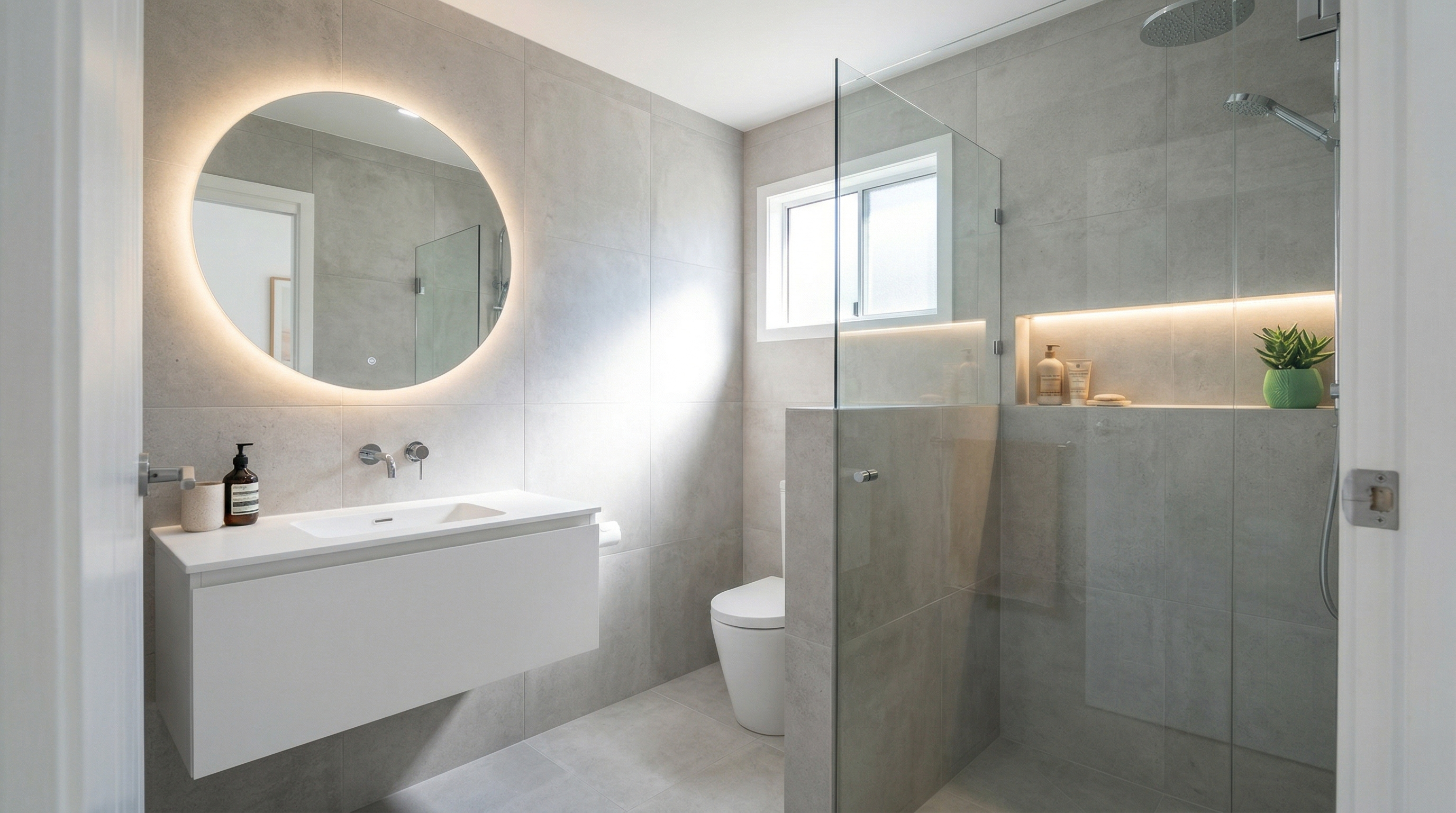
Wall-hung vanity: A floating vanity mounted 150 to 200mm above the floor exposes the tile underneath and makes the room appear larger. Choose a unit at least 600mm wide for practical storage. Slim-profile designs (350 to 400mm depth) work in narrow spaces without sacrificing sink size. Wall-hung vanities start at around $400 for quality off-the-shelf units and suit most small bathroom renovations in Queensland.
Wall-hung toilet: A wall-faced or fully wall-hung toilet with a concealed cistern sits flush against the wall and projects only 500 to 600mm into the room, compared to 700mm or more for a standard close-coupled toilet. The concealed cistern hides inside the wall cavity, which means you lose a small amount of wall depth but gain significant visual and physical floor space.
Recessed niches: Instead of a freestanding shower caddy or corner shelf that protrudes into the shower area, build recessed storage niches directly into the wall during the tiling phase. A niche 300mm wide by 400mm tall by 100mm deep provides ample storage for bottles without encroaching on the shower space.
Tile Selection and Pattern Tricks
Tile choices affect how large or small a bathroom feels, sometimes more than the actual dimensions suggest.
Large-format tiles (600×600mm or 600×300mm): Fewer grout lines create a cleaner, more continuous surface that visually expands the room. Large tiles work on both floors and walls in small bathrooms. They also reduce cleaning effort in Queensland’s humid climate, where mould tends to colonise grout lines.
Continuous floor-to-wall tiling: Using the same tile on the floor and lower walls (or even floor to ceiling) eliminates visual breaks and makes the room feel taller and more unified. This technique is especially effective in wet room layouts.
Light, neutral tones: White, off-white, soft grey, and light warm tones reflect more light and push walls back visually. Save bold colours or dark tones for a single accent wall or niche feature if you want contrast without closing the space in.
Vertical stack bond: Running rectangular tiles in a vertical stack pattern (rather than the traditional horizontal brick bond) draws the eye upward and emphasises ceiling height. This works well in Queenslander bathrooms where ceiling height is generous but floor area is tight.
For slip resistance in wet areas, Australian standards recommend a minimum R10 rating for bathroom floors. In small bathrooms where the entire floor may get wet (especially wet room setups), an R11-rated tile provides extra safety without compromising style. Talk to your bathroom tiling specialist about options that balance grip with aesthetics.
Frameless Glass Opens Up the Space
A frameless glass shower screen, or no screen at all in a wet room, makes the biggest visual impact in a small bathroom. Framed shower screens with thick aluminium profiles create a visual cage that divides the room and makes it feel smaller.
Options ranked by space-saving impact:
- Full wet room (no screen): Maximum openness. Requires full-floor waterproofing and a well-positioned floor drain with correct fall.
- Single frameless panel: A fixed glass panel (800 to 1,000mm wide) provides splash protection without a door. No tracks, no hinges, no frame.
- Frameless pivot door: A clear glass door on a pivot hinge opens in both directions and folds nearly flat against the wall when not in use.
Shower screen installation in small bathrooms requires precise measurement. Even 20mm of error can mean the difference between a door that swings freely and one that clips the vanity.
Lighting and Mirrors That Expand the Room
Natural light is the most effective tool for making any room feel bigger. If your small bathroom has a window, avoid blocking it with frosted film unless privacy absolutely demands it. Consider a louvred window that allows ventilation and light while maintaining privacy, which also helps manage Queensland’s bathroom humidity.
For artificial lighting:
- Recessed LED downlights: Sit flush with the ceiling, avoid visual clutter, and provide even illumination. Two to three downlights suit most small bathrooms.
- Backlit mirror or LED mirror cabinet: Combines task lighting with a soft ambient glow that bounces light around the room. A mirror cabinet also adds concealed storage.
- Avoid pendant lights and wall sconces: These protrude into the room and create shadows in a small space.
An oversized mirror (wider than the vanity) is one of the cheapest and most effective ways to make a small bathroom feel twice its size. Mounting a mirror wall-to-wall above the vanity, or even floor to ceiling on one wall, doubles the visual depth of the room.
Storage Solutions for Small Queensland Bathrooms
Limited floor space means storage has to be vertical, concealed, or built-in:
- Mirror cabinet: Replaces a flat mirror with 100 to 150mm of concealed shelf space. Ideal for toiletries, medications, and daily items.
- Vanity drawers over doors: Drawers use internal space more efficiently than a vanity with swing-open doors. Soft-close drawer runners keep the bathroom quiet in the early morning. Your vanity and cabinetry supplier can recommend compact drawer units that maximise every millimetre.
- Tall narrow cabinet: A slim tower unit (200 to 300mm wide) fits beside a toilet or in a corner and provides vertical storage for towels and supplies.
- Over-toilet shelving: The wall space above a toilet is often wasted. Open shelves or a shallow wall cabinet in this zone add storage without blocking movement.
Ventilation Matters More in Small Spaces
Smaller bathrooms concentrate moisture in a tighter volume, which accelerates mould growth and paint deterioration. Queensland’s subtropical humidity (regularly above 70%) makes this worse. Every small bathroom renovation should include a quality exhaust fan rated for the room size. For bathrooms under 4 square metres, a fan with a minimum 25-litre-per-second extraction rate keeps humidity under control. Ducting the fan to the exterior (not into the roof cavity) is essential, as dumping moist air into a Queensland roof space invites timber rot and mould in the ceiling.
Frequently Asked Questions
Q: How much does a small bathroom renovation cost in Queensland?
A small bathroom renovation in Queensland typically costs between $8,000 and $18,000 depending on the scope. A cosmetic update (new vanity, tapware, paint, accessories) runs $5,000 to $8,000. A full strip-out with new waterproofing, tiling, and fixtures in a bathroom under 4 square metres costs $12,000 to $18,000. Costs can increase if plumbing needs relocating or if asbestos is present in older homes. See our bathroom renovation cost guide for a full breakdown.
Q: Can I fit a bath in a small bathroom?
Yes, but it requires careful planning. Freestanding baths typically need 1,500 to 1,700mm of length and are usually too large for bathrooms under 4 square metres. However, compact back-to-wall baths (1,200 to 1,400mm) and Japanese-style deep soaking tubs (shorter but deeper) can work in small spaces. A bath and shower installation specialist can assess whether a tub fits your layout without compromising the shower or access to the toilet.
Q: What tiles make a small bathroom look bigger?
Large-format tiles in light neutral colours create the strongest sense of space. Tiles sized 600×600mm or 600×300mm have fewer grout lines, which reduces visual clutter. Using the same tile on the floor and walls creates continuity that tricks the eye into perceiving a larger area. Gloss finishes reflect light and add depth, though they require more frequent cleaning. Matte finishes hide water spots better and suit Queensland’s humid conditions.
Q: Is a wet room a good idea for a small bathroom?
A wet room is one of the best layout choices for bathrooms under 3 square metres. By waterproofing the entire floor and eliminating a shower screen or tray, you remove physical and visual barriers that make the room feel cramped. The trade-off is that the entire floor gets wet during showering, which means the toilet and vanity areas will need drying. Proper floor grading toward the drain prevents water pooling. Full-floor waterproofing must meet AS 3740 standards regardless of bathroom size.
Your Small Bathroom Has More Potential Than You Think
The right combination of wall-hung fixtures, frameless glass, large-format tiles, and smart storage turns even the tightest Queensland bathroom into a functional, visually spacious room. Focus your budget on layout and waterproofing first, then let fixture and tile choices do the heavy lifting on style. Browse our directory to find small bathroom renovation specialists near you who understand the unique challenges of compact Queensland bathrooms.
Ready to Start Your Renovation?
Browse our directory to find trusted bathroom renovation specialists across Queensland.